

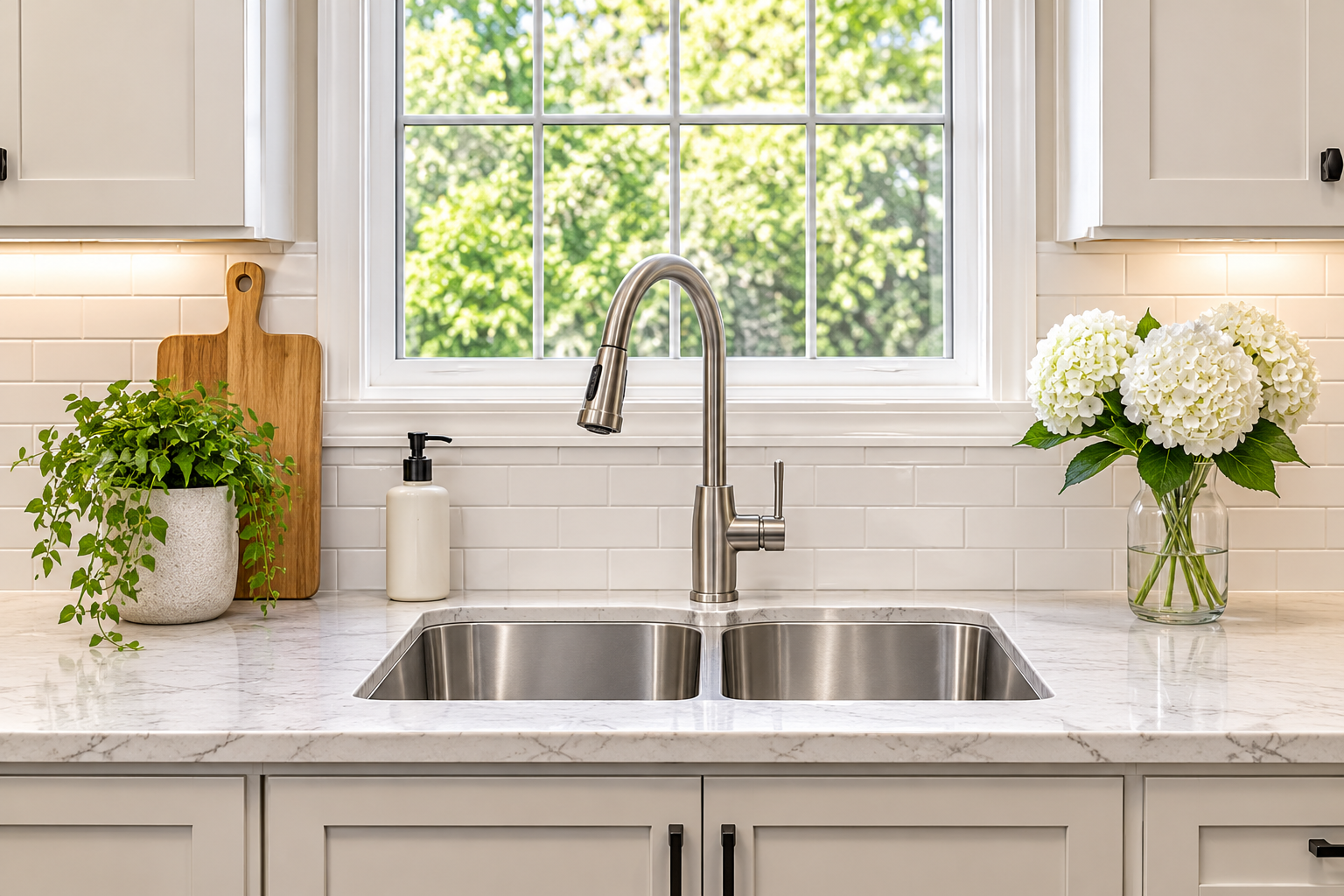
Short answer: The standard kitchen sink dimensions in most homes are about 22 inches front to back, 24 to 33 inches long, and 8 to 10 inches deep. A single bowl usually runs about 24 inches long and an equal double bowl about 33 inches. The sink should be roughly 3 inches narrower than the base cabinet it sits in.
Introduction
Most people pick a sink by how it looks, then find out halfway through the install that the numbers don’t work. The bowl is too shallow for their biggest pot, or the sink is an inch too wide for the cabinet. By then the countertop is often cut, and the fixes get expensive fast.
This guide explains kitchen sink dimensions the way an installer would explain them to a homeowner. You will get the standard sizes, a simple cabinet fit chart, a cookware test, and the details most guides skip, like the gap between listed size and usable size.
Read it before you buy, not after.
Why Kitchen Sink Size Matters More Than You Think
You use your sink more than almost anything else in the kitchen. It is where dishes pile up, vegetables get rinsed and pots soak overnight. A sink that is off by a few inches makes every one of those jobs a little more annoying, and you feel it every single day.
The bigger problem is that sink size is hard to undo. It is tied to the cabinet below it and the countertop cutout around it. The sink choice often gets made late in a kitchen remodel, after the cabinets are already ordered, and that is exactly when a mismatch shows up.
Here is a typical example. A homeowner falls for a 33 inch double bowl, but the base cabinet is the older 30 inch kind. The sink will not fit without cutting into the cabinet frame. Now the choices are a smaller sink, a carpentry job, or new cabinets. A two minute measurement would have prevented all three.
Standard Kitchen Sink Sizes at a Glance
Here are the sizes you will actually find in stores. Every size is listed as length x front to back x depth, in inches, so you never have to guess which number is which.
| Sink Type | Typical size (L x FB x D) | smallest base cabinet | Best For | |
|---|---|---|---|---|
| Single bowl | 24 x 22 x 8 | 27 | Sheet pans, small to mid kitchens | |
| Large single bowl | 30 to 33 x 22 x 9 to 10 | 33 to 36 | Big cookware, heavy cooking | |
| Equal double (50/50) | 33 x 22 x 8 | 36 | Washing and rinsing at once | |
| Offset double (60/40 or 70/30) | 31 to 33 x 20 to 22 x 8 | 36 | One big bowl plus a small prep bowl | |
| Triple bowl | 42 x 20 x 8 | 48 | Large kitchens with separate zones | |
| Workstation | 30 to 45 x 18 to 22 x 9 to 10 | 33 to 48 | Cooks who prep right at the sink | |
| Farmhouse (apron front) | 30 to 36 x 20 to 22 x 8 to 10 | 33 to 42, often modified | Statement look, forward reach | |
| Bar or prep | 15 to 25 x 15 to 20 x 6 to 8 | 18 to 27 | Islands and second sinks |
Sizes vary by maker, and the spec sheet for the exact sink you are buying always wins over any chart, including this one.
If you only remember one number, make it 33 inches. It is the most common double bowl length, and it fits the most common base cabinet, which is 36 inches wide.
How to Read Kitchen Sink Dimensions Without Getting Confused
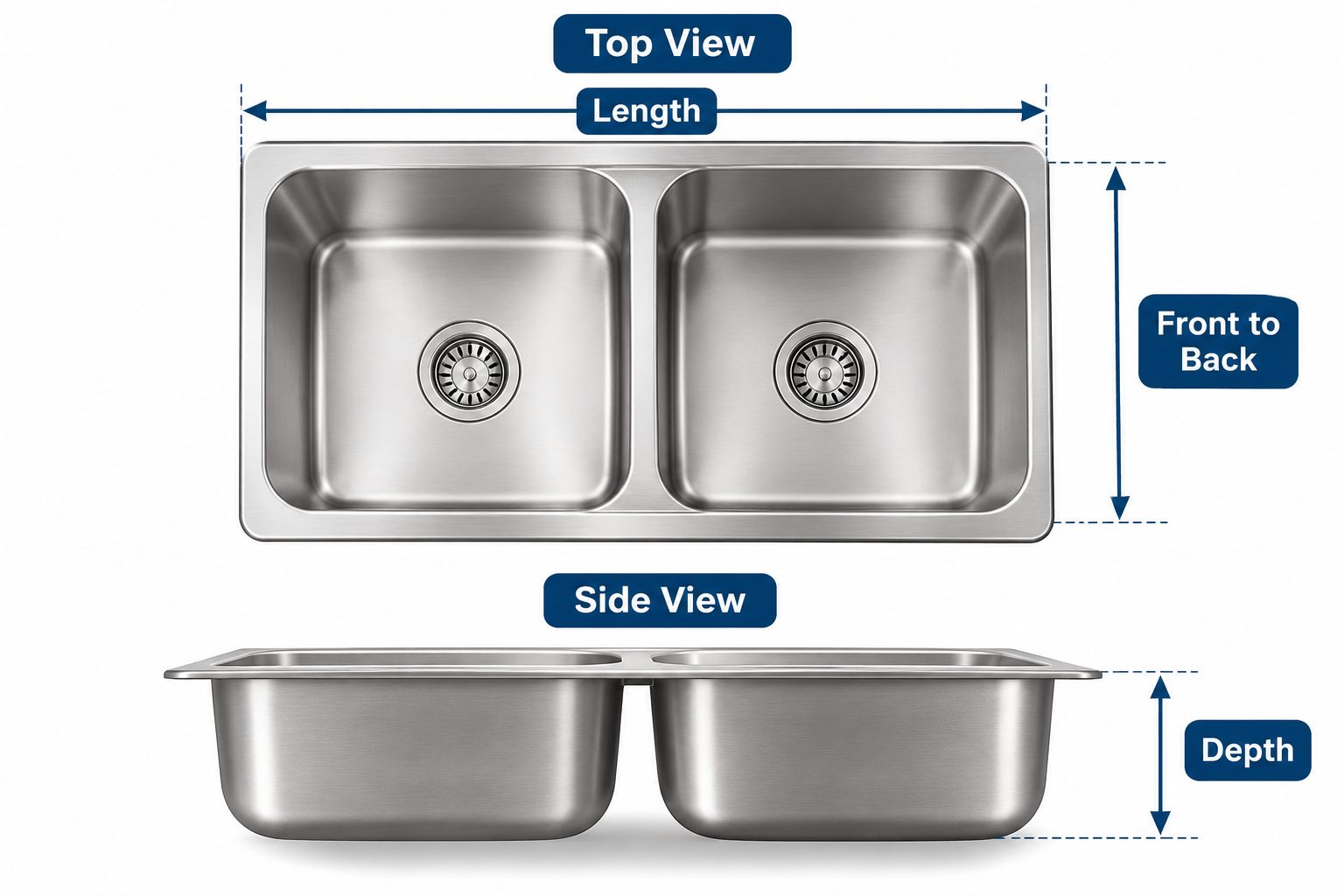
Sink listings are confusing because sellers don’t use the same words. One calls the left to right measurement “width,” another calls it “length.” The front to back number gets swapped the same way. Ignore the labels and look for these three numbers:
- Length: the left to right measurement across the cabinet.
- Front to back: how far the sink reaches toward the wall. 22 inches is typical because most countertops are about 25 inches deep.
- Depth: from the rim down to the bottom of the bowl.
There is a second layer people miss. One listing can hide three different sizes:
- Overall size: the outer edge of the rim or flange.
- Cutout size: the hole in the countertop. For an undermount, it is slightly smaller than the overall size.
- Bowl interior: the space you can actually use for washing.
The bowl interior is what matters day to day. A 33 inch double bowl often gives you two bowls of roughly 14 inches each once you subtract the rim and the center divider. That is why a “big” sink can feel smaller than the number on the box.
Always cut the opening from the manufacturer’s template, not by tracing the sink itself. And if you work in centimeters, 22 inches is about 56 cm, 24 inches about 61 cm, 33 inches about 84 cm, 36 inches about 91 cm, and 8 inches about 20 cm.
Match the Sink to Your Base Cabinet
The base cabinet sets your upper limit. A reliable rule is to pick a sink about 3 inches narrower than the cabinet’s listed width. That leaves room for the cabinet sides and the mounting hardware. Here is how it works out:
- 24 inch cabinet: sinks up to about 21 or 22 inches
- 27 inch cabinet: up to 24 inches
- 30 inch cabinet: up to 27 inches
- 33 inch cabinet: up to 30 inches
- 36 inch cabinet: up to 33 inches
- 42 inch cabinet: up to 39 inches
- 48 inch cabinet: up to 45 inches
Cabinet sizes are nominal, so the inside is a bit smaller. Most 36 inch cabinets measure about 34 to 35 inches inside, which is why a 33 inch sink fits with very little to spare. Squeezing in a 34 inch sink backfires more often than people expect.
Then check the countertop side. Most counters are about 25 inches deep, so a sink that is 22 inches front to back leaves only a few inches to split between the front lip and the back. With an undermount, the faucet mounts in the counter behind the bowl, so that space has to hold the faucet base and the handle sweep. If you have stone counters, ask your fabricator how much solid material they want to keep at the front edge and between the cutout and any seam.
A cheap trick that works: tape the sink outline on the counter with painter’s tape and set the faucet on top. You will see problems in thirty seconds.
Pick the Right Depth
Sinks run from about 6 to 12 inches deep, and 8 to 10 inches covers most homes. Deeper bowls hold stockpots and keep splashes inside. But deeper is not always better. For shorter users it is actually the opposite, because they end up reaching down and leaning over the rim.
- 7 to 8 inches: fine if your dishwasher does most of the work, and it leaves more storage below.
- 9 to 10 inches: best for big pots, roasting pans and batch cooking.
- 11 to 12 inches: only worth it if you are tall or your counter is high. Leaning over a deep bowl wears on your back.
If several people use the sink, go with 8 to 9 inches. A tall person handles a shallow bowl easily, but a short person struggles with a deep one. A bottom grid helps in either case by protecting the finish and lifting dishes closer to you.
Test Your Cookware Before You Buy
Size charts tell you what is standard. They don’t tell you what fits your pans. Good kitchen sink dimensions on paper mean little if your biggest pan will not lie flat in the bowl.
Do this before you order:
- Find your largest pan. A standard half sheet pan is about 18 x 13 inches, and a roasting pan is often around 16 x 13.
- Look up the bowl interior size on the spec sheet, not the overall size.
- Make sure the pan fits flat in at least one bowl with an inch to spare.
This is where the double bowl choice gets real. A 60/40 split works for most households because the big bowl takes the pots while the small bowl handles rinsing or the disposal. An equal 50/50 double looks balanced, but both bowls can end up too small for a sheet pan. That is why some people wash big pans on the counter and wonder why the sink never feels right.
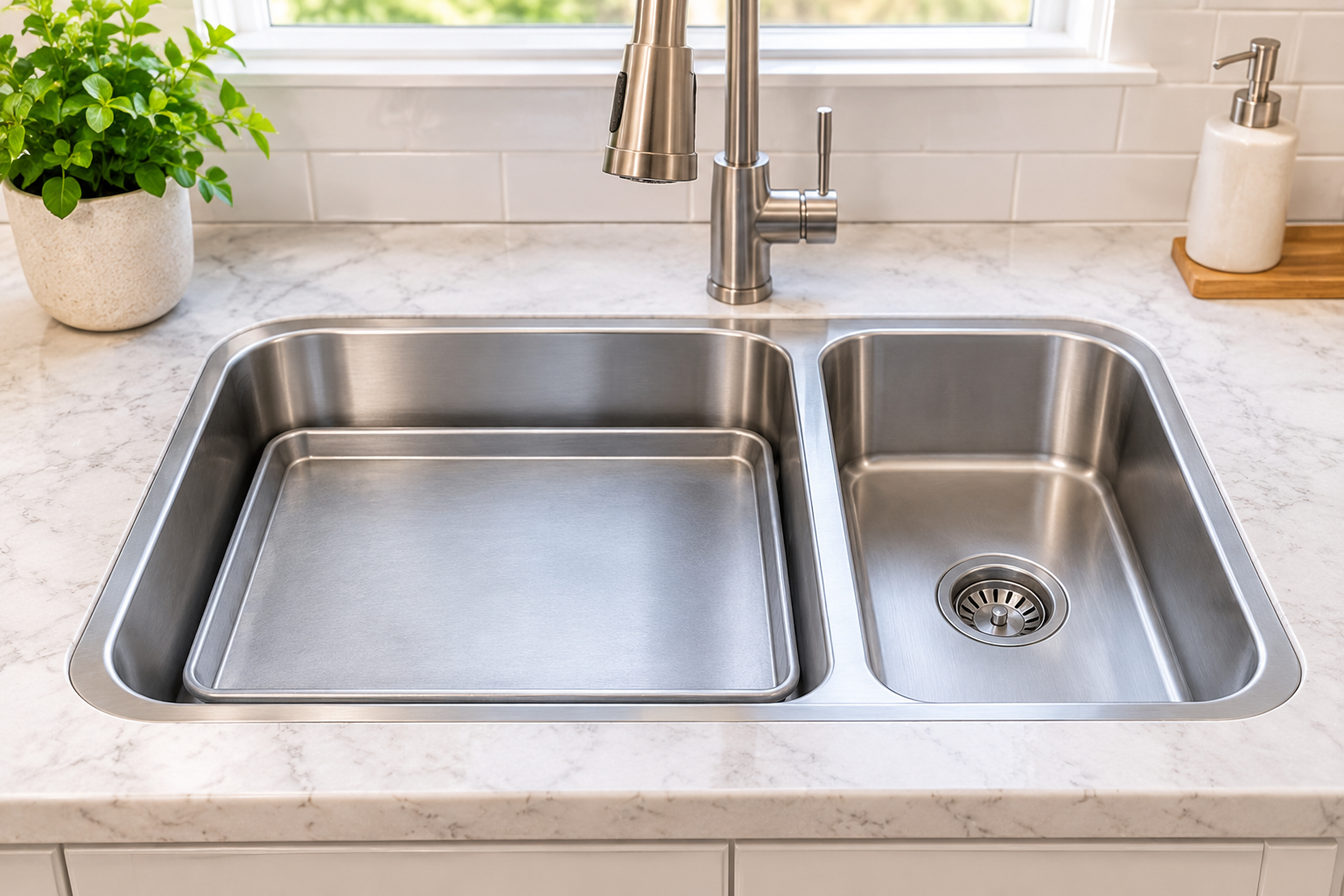
half sheet pan fitting inside a large sink bowl
Which Size Fits Your Situation
Real kitchens don’t follow charts, so here is how the numbers play out in common setups:
- Studio or small apartment: a single bowl around 22 to 24 inches long and 6 to 8 inches deep. It saves counter space and leaves storage below.
- Family of four or five: a 33 inch 60/40 double, 8 to 9 inches deep. One big bowl for pots, one for everything else.
- Avid baker or batch cook: a large single bowl, 30 to 33 inches long and 9 to 10 deep, or a workstation sink with ledges for boards and racks.
- Kitchen island: a bar or prep sink, 15 to 25 inches long, so the main sink stays free for dishes.
- Older 30 inch cabinet: a 27 inch single bowl, unless you are ready to modify the cabinet.
The tradeoff is always counter space. Every inch you give the sink is an inch you lose for prep and drying, so don’t go bigger than your cookware actually needs.
Check the Space Under the Sink
Bowl depth and plumbing fight over the same cabinet. A garbage disposal often stands 10 inches or more below the drain, and you still need room for the P-trap, the dishwasher line, and maybe a water filter or pull-out trash. Add the bowl depth to the disposal height and compare it with the inside height of the cabinet. A rear drain sink can free up a surprising amount of room.
While the cabinet is empty, look at the supply lines and the cabinet floor for stains or soft spots. Slow leaks hide there for years, and it is far easier to deal with them before the new sink goes in (a dripping faucet is usually a simple repair you can finish in an afternoon).
Replacing a Sink: Same Size, Bigger or Smaller
Same footprint is the easy path. Match the cutout and mounting type, and the swap is usually quick.
Bigger means enlarging the cutout. Laminate can be trimmed carefully, but stone can crack if recut, so that job belongs to a fabricator. Also check that the cabinet is wide enough, because the countertop is only half the equation.
Smaller is the trap nobody warns you about. A smaller drop-in can leave a visible gap around the old opening. A smaller undermount can expose the old cutout edge. Fixes include a sink with a wider rim or a new section of countertop, and both cost more than most people expect.
Weight matters on replacements too. Heavy cast iron and fireclay models need extra cabinet support, and a hands-on review of cast iron and steel sinks covers weight, noise and installation in more detail than a spec sheet will.
Material, Gauge and Corner Shape
Material changes how a sink behaves, and it also affects the size you can actually use.
- Stainless steel: the most common choice. A lower gauge number means thicker steel, so 16 gauge is sturdier and quieter than 18 gauge, which is still a solid value pick.
- Granite composite: a matte look and good scratch resistance. Check cabinet support, since these sinks are heavier than steel.
- Fireclay and cast iron: classic and durable, but very heavy.
Corner radius is the quiet detail. Tight corners squeeze more usable space out of the same footprint, while big rounded corners are easier to clean but cost you a bit of room. Steel thickness is the other spec worth checking before you commit, and a side by side comparison of two well known sink makers shows how much gauge and warranty terms can differ.
Specialty Sinks and Accessible Setups
- Farmhouse or apron front: the front face replaces part of the cabinet front, so expect cabinet modification and extra support. Many run 30 to 36 inches long and 8 to 10 inches deep.
- Workstation: built in ledges for cutting boards and colanders. Widths run from about 30 to 45 inches, and depths are usually 9 to 10 inches.
- Corner: useful in L shaped layouts where the corner is dead space.
- Accessible setups: the ADA standards generally call for the rim or counter to be no higher than 34 inches, with about 27 inches of knee clearance underneath. Shallow bowls, roughly 5 to 6.5 inches deep, and a rear drain make these sinks easier to use. Check the current standard and your local code before you buy.
A 10 Minute Measuring Routine
You don’t need special tools, just a tape measure, painter’s tape and a notepad.
- Inside the cabinet (2 minutes): open the doors and measure the inside width, then note the cabinet’s listed width.
- Counter depth (1 minute): measure from the front edge to the wall.
- Old sink or cutout (2 minutes): measure the existing opening and note whether it is drop-in or undermount.
- Under the sink (2 minutes): check the drain position, disposal, dishwasher line and the distance from the cabinet floor to the underside of the sink.
- Tape test (2 minutes): outline the new sink on the counter and place the faucet.
- Write it down (1 minute): compare your numbers with the spec sheet’s minimum cabinet size and cutout size.
Once those numbers are written down, shortlisting gets easy, and a roundup of the best kitchen sink brands saves a lot of browsing time at that stage.
Frequently Asked Questions
What is the standard size of a kitchen sink?
Most sinks are about 22 inches front to back and 24 to 33 inches long, with a depth of 8 to 10 inches. The most common double bowl is 33 x 22 x 8.
Will a 33 inch sink fit in a 36 inch cabinet?
Usually yes. A 36 inch cabinet commonly measures 34 to 35 inches inside, so confirm with the spec sheet and the template, especially for undermount and apron front models.
How deep should a kitchen sink be?
About 8 inches works for light to medium use, and 9 to 10 inches suits big cookware. Go shallower for accessible setups or shorter users.
What is the difference between a 50/50 and a 60/40 double bowl?
A 50/50 has two equal bowls. A 60/40 has one larger bowl for pots and a smaller one for rinsing or the disposal, which is more practical for most households.
Can I put a bigger sink in my existing cabinet?
Only if the cabinet is wide enough, and the countertop cutout usually has to be enlarged. Laminate can sometimes be trimmed, but stone should be cut by a professional.
Conclusion
Getting kitchen sink dimensions right comes down to three checks: the cabinet width, the countertop depth, and the pans you actually use. Do those in about ten minutes with a tape measure, and most expensive mistakes disappear before they happen.
Stick with the 3 inch cabinet rule, pick a depth that suits the people using the sink, and always trust the manufacturer’s spec sheet and template over any chart. If you are replacing an old sink, remember that going smaller can cause more headaches than going bigger.
Measure first, shop second, and the sink you choose will fit your kitchen the way it is supposed to.